Reprogramming the cell’s protein-making machine provides easier access to bioplastics.
By Chandrima Majumdar
The birth of the biotech industry in the San Francisco Bay Area can be traced back to a single breakthrough: recombinant DNA technology. By introducing human genes into bacteria, scientists hijacked the microbes’ protein synthesis machinery to produce lifesaving medicines like insulin.
Now scientists at the NSF Center for Genetically Encoded Materials (NSF C-GEM) are working towards engineering the same protein synthesis machinery to biosynthesize more diverse therapeutic peptides and bioplastics.
This type of genetic programming is possible because proteins are produced by a process called “translation,” which takes place in almost the same way across all domains of life, from bacteria to yeast to human beings. The central player in translation is the ribosome—a molecular machine that assembles the protein’s building blocks (amino acids) in a specific order to make proteins.
For building blocks to join, each piece needs to have interlocking parts that can fasten to pieces on either side, like the studs and grooves of LEGO bricks. For amino acids, these interlocking parts are chemical groups that react with each other—one end of the molecule has an amine group, and the other end has a carboxylic acid group. These molecules also have side chains that naturally come in twenty different varieties, like differently shaped LEGOs; these variants can form different structures but are connected by the ribosome in the same way.
Just as varying the number, shape, and arrangement of LEGO blocks can make completely different structures, doing the same with amino acids gives rise to proteins with distinct properties and functions. For instance, in our own bodies, muscle proteins are completely different from the proteins that make up our hair or nails.
Scientists at NSF C-GEM are working to expand the molecular building blocks of the ribosome to include modified amino acids and hydroxy acids, like adding differently shaped bricks to a LEGO kit to make new and more complex models. This is a challenging proposition, since the ribosome has been finely tuned for millions of years to only connect natural amino acids to each other.
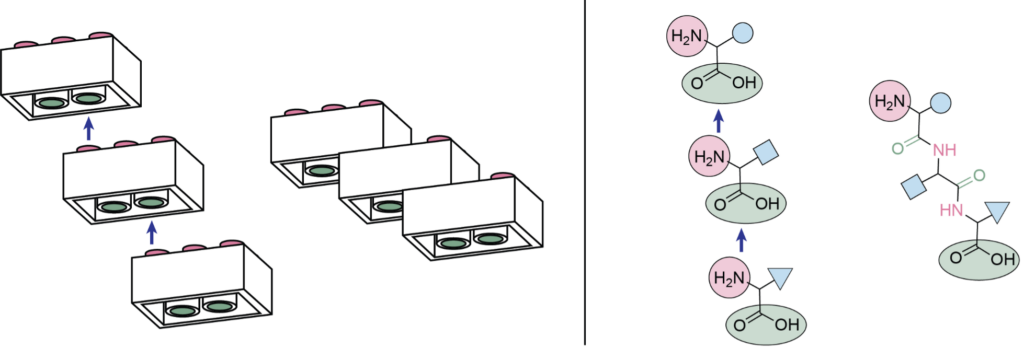
Expanding the substrate scope of the ribosome would be useful because many modern peptide drugs—most famously, GLP-1 agonists—contain modified amino acids that are essential for their efficacy. Currently these drugs are produced through a process that relies on specialized and hazardous chemicals that are both expensive and difficult to work with.
Engineering the bacterial ribosome to produce peptides carrying modified amino acids is one way of solving this problem in a more economical and environmentally conscious manner. Researchers in Jamie Cate and Alanna Schepartz’s labs at UC Berkeley are approaching this challenge from two different directions.
In the first approach, the Schepartz lab conducted studies to evaluate how far they can push the ribosome to accept new molecules. They examined if β-hydroxy acids—molecules that are larger than amino acids since they have an extra carbon atom in their backbones—would be translated by the ribosome. Biosynthesizing ester-peptide hybrids can lead to easier access to existing therapeutic natural products and lead to more scalable syntheses of new materials and bioplastics.
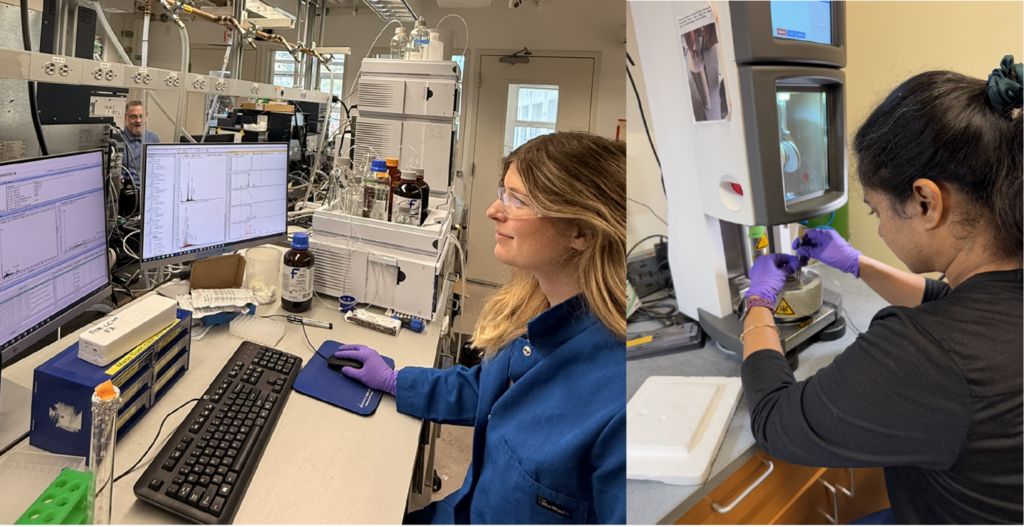
Inside the ribosome, two amino acids are positioned such that the amine group of one of them is pointed directly at the carbonyl group of the preceding one and is placed close enough to form a bond. The ribosome has been fine-tuned over millions of years to perfectly orient natural amino acids for this reaction, so much so that even the mirror image (stereoisomer) of natural amino acids can’t be efficiently oriented for bond formation.
Like natural amino acids, β-hydroxy acids also come in two varieties that are mirror images to each other (stereoisomers). In a recent publication in the Journal of the American Chemical Society, researchers in the Cate lab used high-resolution cryo-EM structures to visualize how each stereoisomer of a β-hydroxy acid is arranged in three-dimensions inside the ribosome.
“We wanted to know how having an extra carbon atom in the backbone of β-hydroxy acids would affect their ability to react in the ribosome” said Alexandra Kent, a postdoctoral researcher in the Cate lab.
To their surprise, they found that instead of causing problems, the extra backbone carbon allowed both stereoisomers to be positioned equally well inside the ribosome. It turns out that the presence of the additional carbon atom causes the reactive hydroxyl groups to end up at the same position for both stereoisomers, indicating that both should react equally well within the ribosome.
The researchers then used mass spectrometry to confirm that, in vitro, they were able to obtain equal quantities of ester-peptide hybrids carrying a single copy of one or the other stereoisomer, showing that the ribosome can indeed accept molecules distinct from natural amino acids.
Spurred by this success, the scientists next asked if the ribosome could string together multiple β-hydroxy acids in a row to biosynthesize a β-polyester-peptide hybrid molecule, something that had never been made using a ribosome before. This process posed its own challenges since the additional backbone carbon in the β-hydroxy acids that gave them an advantage in the previous study, now caused them to get stuck in the exit tunnel—the passage through which proteins are ejected from the ribosome.
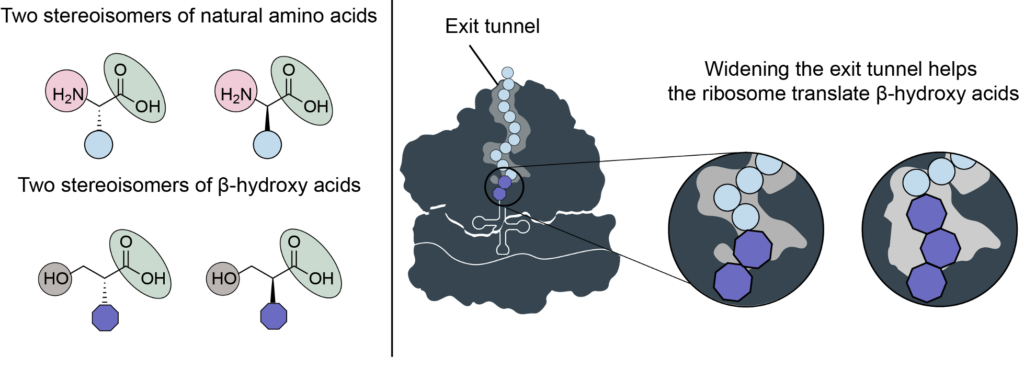
Right: Proteins come out of the ribosome through a passage called the “exit tunnel.” Since β-hydroxy acids (represented by the purple octagons) are larger than natural amino acids, they are blocked from exiting by a constriction in the exit tunnel. In a recent publication, researchers showed that widening this tunnel helps the ribosome translate β-hydroxy acids.
To get around this problem, researchers in the Cate lab pursued a second approach. They applied structural insights from another difficult sequence that is also known to stall in the exit tunnel and reasoned that relieving that bottleneck may generally help with translating challenging sequences.
The bottleneck turned out to be a constriction at the mouth of the exit tunnel. In another set of cryo-EM structures described in a new publication in ACS Central Science, the Cate lab showed that difficult sequences can be translated more efficiently when the ribosome is mutated to have a wider opening into the tunnel.
“Mutating the ribosome can be tricky because making a change to the wrong position can lead to complete loss of activity,” observed Kent. “Luckily, the mutation that we chose to relieve the bottleneck was as active as a wild-type ribosome.”
Encouraged by these findings, the authors tested the mutant ribosome with β-hydroxy acids and found that widening the mouth of the tunnel allowed the ribosome to incorporate three β-hydroxy acids in a row, thus enabling the ribosomal biosynthesis of a β-polyester-peptide hybrid—something that has never been demonstrated before.
“The ribosome has over four thousand nucleotides and altering just one of them allowed us to expand its functionality,” said Kent. “This work highlights how a very small perturbation to a very large macromolecule can have profound effects on its activity.”
In an era where AI tools have become powerful enough to design proteins with specific functions from scratch, expanding the suite of molecules that the ribosome can accept will enable us to design proteins and peptides with novel and specific functions. These advancements from the Cate and Schepartz labs show that the bacterial ribosome can be engineered to accept molecules distinct from natural amino acids.
The ability to biosynthesize hybrid peptides in laboratory bacteria—making the process cheaper and safer—can revolutionize the types and ease of production of therapeutics. Engineering the bacterial protein synthesis machinery to accept a broader range of molecules can even lead to the production of materials like polyesters and bioplastics and carry on the legacy of producing beneficial molecules through recombinant DNA technology.